

Temecula Will Attorney
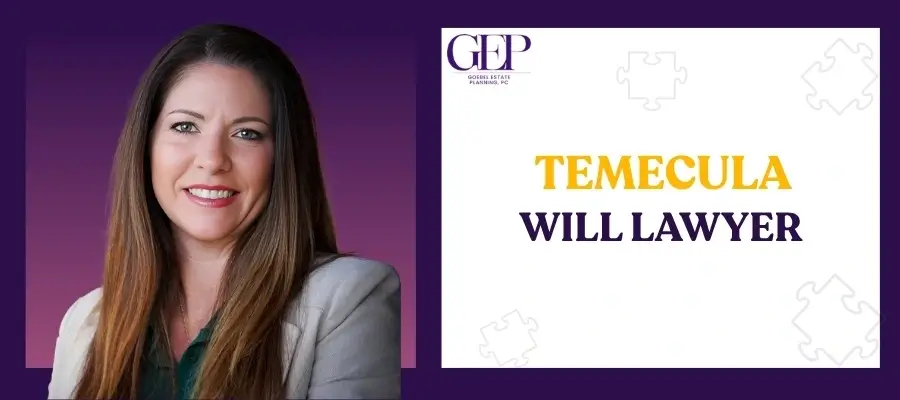
Temecula Will Lawyer
Estate planning is an effective and compassionate way to provide security, support, and compassion for your loved ones after you are gone. Estate plans can benefit multiple generations if they are completed with care and the correct legal knowledge. With so many options exist in this field, it is crucial to have the guidance of an empathetic and dedicated estate planning attorney.
A skilled Temecula Will Attorney can help you understand your options, ensuring you make the right choice for yourself, your family, and your beneficiaries regarding your assets, no matter their worth or form.
Hire a Will Attorney
If you choose to craft a will as part of your estate plan, Goebel Estate Planning, PC, can help your vision become reality and secure appropriate and personalized access to your assets for your loved ones. Every family has different needs, and regardless of your situation, attorney Hillary Goebel can ensure that you receive a thoughtful, hands-on approach. That way, you can feel confident in the choices you have made for the future of your finances and your family.
Hillary Goebel at Goebel Estate Planning, PC, in Temecula, California
Attorney Hillary Goebel has worked for decades helping clients in Temecula, CA design wills and estate plans that outline in detail their exact requirements for what will happen to their assets and their families after they have passed on.
Although writing a will is an emotionally charged event, fraught with stress and conflicting feelings from multiple family members, the burden of this stressful time can be lifted by working with an attorney who can offer not only precise knowledge of this legal field but also empathy, patience and, most of all, her time.
Whether you are seeking an estate planning attorney for just a will or are potentially interested in exploring your options in trusts and California probate, attorney Hillary Goebel is passionate and wholly committed to providing clients with a personalized experience She can afford them relief, knowing that their family can be protected and provided for in any event and that their legacy can be intact for future generations.
What Is A Will?
A will is the most common tool used in estate planning. It provides a detailed description of the outcomes of a person’s assets after they pass away. Typical types of assets included in a will can be automobiles, homes and other real estate, savings accounts, and other items that have monetary or sentimental value to the person or family.
Many people may mistakenly believe that a will should be drafted later in life or at a point where a person’s health is failing and they may not survive for many more years. However, wills can be created at any time in a person’s life, and it is actually never too early to begin the process to ensure that any beneficiaries receive the assets that you wish for them to acquire.
Not only can a will ensure that your assets are passed down in accordance to your personal desires, but it can also provide care and protection to any dependents who may still be minors at the time of your death. No one can predict a tragedy, and crafting a will that details who will care for minor dependents can ensure that they do not get put into foster care or given to an unscrupulous family member or outside party.
A will must always have an executor, who is the person you designate to distribute your assets as outlined to the beneficiaries. They are legally required to follow your wishes as an executor, and this is another level of protection for you and your loved ones. If a person dies and has not named an executor or created a will, it follows that an executor will be named by the court, and any assets will be given to your next of kin, regardless of what your wishes may have been.
What Happens If You Die Without a Will in Temecula?
In the U.S., only about 32% of adults have a will in place that describes what to do with their assets after their death. When a person dies without a valid will, they are considered to have died intestate. Their assets are distributed according to California’s intestate succession laws rather than personal preferences or informal promises made during their lifetime.
Under state law, a surviving spouse or registered domestic partner may inherit some or all the estate. The amount depends on whether the property is community or separate property and whether the deceased person left children or close relatives. Property that does not pass to a surviving spouse generally goes first to children, followed by parents, siblings, and more distant relatives.
California’s intestate succession rules do not generally provide an inheritance for unmarried partners, friends, charities, or other people who are not legally recognized relatives. The Superior Court of California’s probate division will also appoint a personal representative to handle the estate, which may not be the person the deceased would have selected.
What’s more, if minor children lose both parents, a judge will determine who should serve as guardian based on the child’s best interests. A will records your preferences instead of leaving decisions up to the court.
Wills vs. Trusts
A trust is another tool used in estate planning that can guard your assets. It is a specific type of account wherein you may place your assets. In doing so, you assign another person, known as the trustee, to take care of the account and your assets. There are multiple types of trusts that can pertain to both financial assets and a person’s healthcare. Although a will is less complicated, a trust can offer greater protection against taxes and probate.
If you decide to create a trust, after you pass away, your trustee will then be called upon to convey your stipulations by distributing the assets you outlined. Provided that the trust has been drafted by a responsible and knowledgeable attorney who understands the proper protocol under California estate law, your trust can avoid going to probate court.
Moreover, if you choose a living trust, this will buy you more time to alter any verbiage of the trust before you are gone. You may also be able to minimize mandatory taxes with an irrevocable trust, although this type of trust is not accessible or alterable once the draft is finalized.
What is a Probate?
Probate court occurs when the state determines that it must settle any of the deceased’s debts. These include unpaid taxes, personal loans, and probate fees. Creating a will or trust can minimize or eliminate the time-consuming and costly need for your documents, or lack thereof, to be seen by a judge, who must decide if they are valid under the eyes of the law.
Even if you chose a trustee and assigned them to your estate administration, there is still a chance that the documents will need to be reviewed in probate. The more thorough and complete your will or trust is, the better your beneficiaries’ chances of quickly acquiring access to your assets upon your death and preventing any further litigation.
What Makes a Will Legally Binding in California?
Under California Probate Code § 6100.5, a person must have testamentary capacity when creating a will. This means understanding that they are making a will, recognizing the nature of their property, and understanding their relationships with close family members and others affected by the document. A standard will is required to be written and signed by the person making it.
Two witnesses must be present together to observe the signing or the testator’s acknowledgment of the will, according to Probate Code § 6110. Each witness must sign while the testator is still alive, and it must be clearly explained to them that they are witnessing the signing of a will. California does not strictly require disinterested witnesses. However, the law creates a presumption of wrongdoing if a witness receives a gift under the will and there are not two other disinterested witnesses.
The Dangers of DIY and Handwritten Wills
California recognizes holographic wills, or handwritten wills, when the signature and material terms are in the testator’s handwriting. These wills do not require witnesses, but unclear language, missing terms, conflicting documents, or uncertainty about the date can lead to litigation.
Online forms can create similar problems when they are completed or signed incorrectly. A will attorney can confirm capacity, oversee proper execution, use disinterested witnesses, and craft a document that addresses California law. Legal guidance for your will case reduces the risk that a probate court could reject the will or interpret its provisions differently than intended.
Why Are Wills Contested?
While 55% of adults over the age of 50 have some form of a will in place, this doesn’t mean their documents won’t be contested after they pass. A relative or other interested person cannot successfully challenge a will simply because they dislike its terms, but there are legal mechanisms in place that allow contention. A challenge must generally raise a legal issue affecting whether the document accurately represents the deceased person’s valid wishes.
Under California Probate Code § 8252, common grounds for a will contest include lack of testamentary capacity, undue influence, fraud, duress, mistake, and revocation. A challenger might allege that the person did not fully understand the document, was pressured by a relative or caregiver, or signed because of deliberately false information. Questions may also arise when the signature appears forged or when the will was not properly witnessed.
Conflicting documents can create another dispute. If the family discovers a newer will, the court must determine which document controls and whether the later version properly revoked the earlier one. Contests may require testimony, medical records, financial documents, or handwriting evidence. Careful drafting, proper execution, and clear records of the person’s decisions can make the will easier to defend and reduce uncertainty during probate.
FAQs About Temecula, CA Will Laws
How Much Does an Attorney Charge for a Will in Temecula?
The cost for an attorney to create your will in Temecula depends on the complexity of your estate, the services you need, and the experience of the Temecula will lawyer. A basic document may cost less than a plan involving several beneficiaries, minor children, business interests, or detailed distribution instructions. Fees may be a flat or hourly rate. During an initial consultation, an attorney can review your goals, explain the process, and provide an estimate on the cost.
What Makes a Will Legally Valid in California?
To be legally valid, a standard will must be authored and signed by the person making it, known as the testator. The testator must understand what the document does and have the mental capacity to create it. At least two people must witness the signing or acknowledgment and sign during the testator’s lifetime. The witnesses must understand that the document is the testator’s will. Note that handwritten wills, while legal, follow different requirements.
What Assets Cannot Be Distributed Through a Will in California?
A will cannot control assets that already have a legally designated recipient or pass automatically at death. Examples include life insurance proceeds, retirement accounts, and payable-on-death bank accounts with named beneficiaries. Property owned in joint tenancy usually passes directly to the surviving owner. Assets placed in a living trust are distributed under the trust’s instructions rather than the will. Transfer-on-death and registered securities may also pass outside the will.
What Is the Biggest Mistake with Wills?
One of the biggest mistakes with wills is creating the document and then never updating it. Major life changes, including marriage, divorce, births, deaths, property purchases, or changes in relationships, can leave your instructions outdated. An old will may name the wrong executor, omit a child, or direct property to someone you no longer intend to benefit. Review your will every few years and after significant events so that it reflects your wishes and follows the state’s will laws.
Contact A Temecula Will Attorney Today
When you contact attorney Hillary Goebel, you’re taking the first step to planning for the future of your estate. She can work with you to craft a will that provides security, safety, and loving closure for your family when the time comes. The size of your estate is of no consequence, nor is your familial situation. Ms. Goebel is here to offer the support and services you need.
Goebel Estate Planning, PC, has the tools and compassionate, personalized services to design and finalize your will. Your family’s future is important, and she can help you move forward with the first steps. Contact her office online today to hire a will attorney. Let her knowledge and experience help provide you with the peace of mind you and your beneficiaries deserve.

Meet Attorney
Hillary Goebel
Founder, Goebel Estate Planning
Estate planning is an effective and compassionate way to provide security for your loved ones after you are gone. Hillary Goebel helps clients in Temecula craft comprehensive Last Wills and Testaments that clearly outline their wishes and protect their legacies. Whether you need to designate guardians for minor children or ensure specific assets are distributed correctly, Hillary provides the personalized legal guidance needed to avoid future conflicts and ensure your family is cared for.
Client Testimonial


Copyright © 2026 Goebel Estate Planning. All Rights Reserved. Disclaimer | Site Map | Privacy Policy
*Images are obtained under license from Canva and other third-party stock image providers, with attribution included where required.
Digital Marketing by 